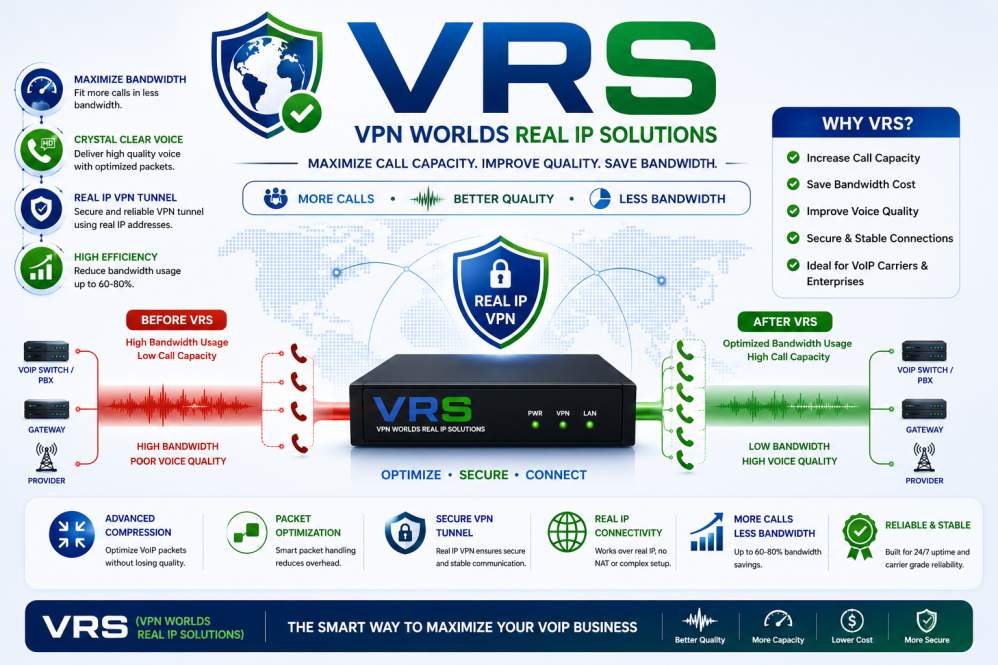
What Is ViBE VoIP Bandwidth Optimization?
ViBE (Voice over IP Bandwidth Enhancement) is a patented VoIP bandwidth optimization technology designed to dramatically reduce bandwidth consumption while maintaining business-grade call quality. Unlike standard VPN solutions that merely encrypt traffic, ViBE operates at the packet level to compress RTP headers, optimize packet overhead, and implement intelligent Quality of Service (QoS) specifically engineered for real-time voice communication.
The global VoIP market is projected to reach $170.22 billion in 2026 with a CAGR of 15.9%, driven by increasing demand for cost-effective international communication. However, VoIP traffic faces significant challenges on broadband and ADSL networks: asymmetric bandwidth, high packet overhead, poor QoS on low-speed links, and ISP throttling. ViBE addresses each of these challenges through advanced compression algorithms and intelligent traffic management.
Core Features of ViBE Technology
RTP Header Compression
Byte-Level QoS
Anti-Block Routing
Dynamic Jitter Buffer
All-Codec Support
Encrypted Tunnels
How ViBE VoIP Optimization Works
The Problem with Standard VoIP Over Broadband
Standard VoIP over broadband and ADSL networks faces several critical challenges that degrade call quality and limit scalability:
- Asymmetric bandwidth: ADSL provides much lower upstream bandwidth (typically 256 kbps) compared to downstream, severely limiting concurrent calls.
- Packet overhead waste: Each VoIP packet carries 40+ bytes of IP/UDP/RTP headers. For a 20-byte voice payload, this represents 67% overhead.
- Ineffective QoS: Standard QoS techniques fail on links below 1 Mbps, and cannot reliably allocate more than 70% of available bandwidth.
- SIP ALG interference: Router-based SIP ALG modifies packet headers unpredictably, causing registration failures, one-way audio, and dropped calls.
- ISP throttling: Many ISPs actively detect and throttle SIP/RTP traffic, causing unstable connections and poor voice quality.
The ViBE Solution
ViBE directly and effectively tackles each of these critical challenges and obstacles through its advanced, cutting‑edge proprietary optimization technology framework:
- RTP Header Compression (cRTP): Compresses 40-byte headers down to 2-4 bytes, reducing per-call bandwidth from 42+ kbps to as low as 8-10 kbps.
- Byte-Level QoS: Prioritizes VoIP packets at the byte level rather than device level, ensuring voice traffic always receives preferential treatment.
- Dynamic Bandwidth Allocation: Intelligently manages available bandwidth between voice and data, allowing both to coexist without degradation.
- SIP ALG Bypass: Encapsulates SIP traffic to prevent router ALG interference, eliminating registration failures and one-way audio issues.
- Multi-Tunnel Encryption: Supports 15+ tunnel types with strong encryption to bypass ISP restrictions and protect traffic.
ViBE Technical Specifications
| Performance Metrics | |
|---|---|
| Bandwidth Reduction | Up to 80% |
| Header Compression | 40 bytes → 2-4 bytes |
| Concurrent Calls (256K) | 5x more than standard |
| Latency Target | < 150ms one-way |
| Jitter Tolerance | < 30ms |
| Packet Loss Recovery | < 1% effective |
| Compatibility | |
|---|---|
| Supported Codecs | G.729, G.711, G.723.1, GSM, iLBC, Speex |
| SIP Platforms | Asterisk, FreePBX, VOS3000, Elastix |
| Gateway Support | GOIP, Dinstar, Skyline, Antrax, Hybertone |
| Router Firmware | OpenWrt, DD-WRT, Tomato, MikroTik |
| Operating Systems | Windows, Linux, macOS, Android, iOS |
| Tunnel Types | 15+ encrypted tunnel protocols |
Who Benefits from ViBE?
Call Centers
Reduce bandwidth costs while maintaining agent call quality and increasing concurrent call capacity.
VoIP Carriers
Optimize wholesale routes, improve ASR/ACD metrics, and reduce operational infrastructure costs.
Enterprise
Connect multi-site offices with secure, optimized VoIP tunnels over existing internet connections.
GSM Termination
Maximize GOIP gateway efficiency with stable SIP registration and optimized RTP streams.
ViBE Optimized for Africa VoIP Markets
The Middle East & Africa VoIP market accounted for $15.36 billion in 2025 and is projected to reach $17.28 billion in 2026, representing significant growth opportunities for VoIP service providers. However, African VoIP businesses face unique challenges including ISP blocking, limited bandwidth, high latency international routes, and unstable SIP traffic.
VPN Worlds ViBE technology is specifically engineered for African network conditions. Our optimization infrastructure serves key markets including Nigeria, Ghana, Kenya, Uganda, Tanzania, South Africa, Ethiopia, and Cameroon — providing stable, low-latency VoIP connectivity that bypasses local restrictions and maximizes available bandwidth.
Common African VoIP Challenges
- ISP VoIP blocking and SIP port restrictions
- Limited international bandwidth and high costs
- Unstable ADSL and mobile data connections
- SIP ALG interference on consumer routers
- High latency to European and Asian routes
- Expensive leased line alternatives
ViBE Solutions for Africa
- Encrypted tunnels bypass ISP restrictions
- 80% bandwidth reduction lowers data costs
- Optimized for 3G/4G and satellite connections
- SIP ALG bypass eliminates router issues
- Local POPs in key African cities
- Redundant routing for 99.9% uptime
ViBE vs Standard VoIP
| Feature | Standard VoIP | ViBE Optimized |
|---|---|---|
| Bandwidth per Call (G.729) | 42+ kbps | 8-10 kbps |
| Calls on 256K Link | 3-4 calls | 15-20 calls |
| RTP Header Size | 40 bytes | 2-4 bytes |
| QoS Effectiveness | Limited below 1 Mbps | Works at any speed |
| ISP Blocking | Vulnerable | Bypassed |
| SIP ALG Issues | Frequent problems | Eliminated |
| Packet Loss Recovery | Standard | Advanced concealment |
Frequently Asked Questions About ViBE
What is ViBE VoIP Bandwidth Optimization?
ViBE (Voice over IP Bandwidth Enhancement) is an advanced VoIP bandwidth optimization technology that compresses RTP headers, reduces packet overhead, and implements byte-level QoS to reduce bandwidth consumption by up to 80% while maintaining crystal-clear call quality.
How much bandwidth can ViBE save?
ViBE can reduce VoIP bandwidth usage by up to 80%. A standard G.729 call that typically uses 42+ kbps can be optimized to as low as 8-10 kbps, allowing significantly more concurrent calls over the same internet connection.
Is ViBE compatible with GOIP gateways?
Yes, ViBE is fully compatible with GOIP gateways, GSM termination devices, SIP trunking systems, and VoIP PBX platforms including Asterisk, FreePBX, VOS3000, and other major softswitch solutions.
Does ViBE work in Africa and low-bandwidth regions?
ViBE is specifically engineered for challenging network environments including Africa, Asia, and regions with limited bandwidth. It optimizes VoIP traffic over ADSL, 4G/LTE, satellite, and shared broadband connections.
What codecs does ViBE support?
ViBE supports all major VoIP codecs including G.729, G.711 (a-law and mu-law), G.723.1, GSM-FR, iLBC, and Speex. The technology works at the packet level, making it codec-agnostic.
How does ViBE improve call quality?
ViBE improves call quality through dynamic jitter buffer management, packet loss concealment, intelligent packet prioritization (QoS), and RTP header compression. These technologies work together to minimize latency, jitter, and packet loss.
Can ViBE bypass ISP VoIP blocking?
ViBE includes advanced tunneling and encryption capabilities that help bypass ISP VoIP restrictions, SIP ALG interference, and traffic shaping. Combined with VPN Worlds secure tunnels, it creates a robust anti-block solution.
What is the difference between ViBE and standard VPN?
While a standard VPN encrypts traffic, ViBE specifically optimizes VoIP packets at the protocol level. It compresses RTP headers (from 40 bytes to as little as 2 bytes using cRTP), implements voice-specific QoS, and manages bandwidth allocation dynamically for real-time communication.
Complementary Services
VPN4GW
Advanced bandwidth optimization with real public IP VPN for enterprise VoIP networks.
Real IP VPN
Dedicated public IP addresses for stable SIP registration and inbound calling.
SimPro
Non-CLI SIM saver solution for GSM termination and SIM gateway optimization.
Call Filter
Reduce VoIP blocking and improve call completion rates with intelligent filtering.
Ready to Reduce Your VoIP Bandwidth Costs?
Join thousands of VoIP providers, call centers, and carriers who trust VPN Worlds ViBE technology to optimize their voice networks. Start with a free demo or view our pricing plans.
Request Free Demo View Pricing30-day money-back guarantee | 24/7 technical support | Global infrastructure